
Sign up here
If you want to become part of KNOCA’s community and receive our regular newsletter and details of upcoming events please click on ‘Sign up’.
Sign up
The distinctive feature of a climate assembly is that it brings together a diverse group of people selected by democratic lottery to learn, deliberate and come to recommendations. Everyone should have a chance to be included and as such assembly members should resemble the wider population from which they are drawn. This gives climate assemblies legitimacy. Anyone looking at the assembly should see someone like themselves in the room, not the usual vocal minority, politically confident or those with a strong political interest. This diversity of assembly members is also important for making good proposals. Too often political decisions are made by small groups of people with very similar backgrounds and outlooks that fail to account for the lived experience of other social groups, particularly the most vulnerable. In contrast, citizens’ assemblies draw on diverse views, knowledge and experience.
A common misconception of assemblies is that they are full of climate activists. Getting recruitment right – and telling people about it – is important to defend against misunderstandings and, at times, calculated political attacks. But it takes resources, care and attention. Cutting corners in recruitment can undermine the process.
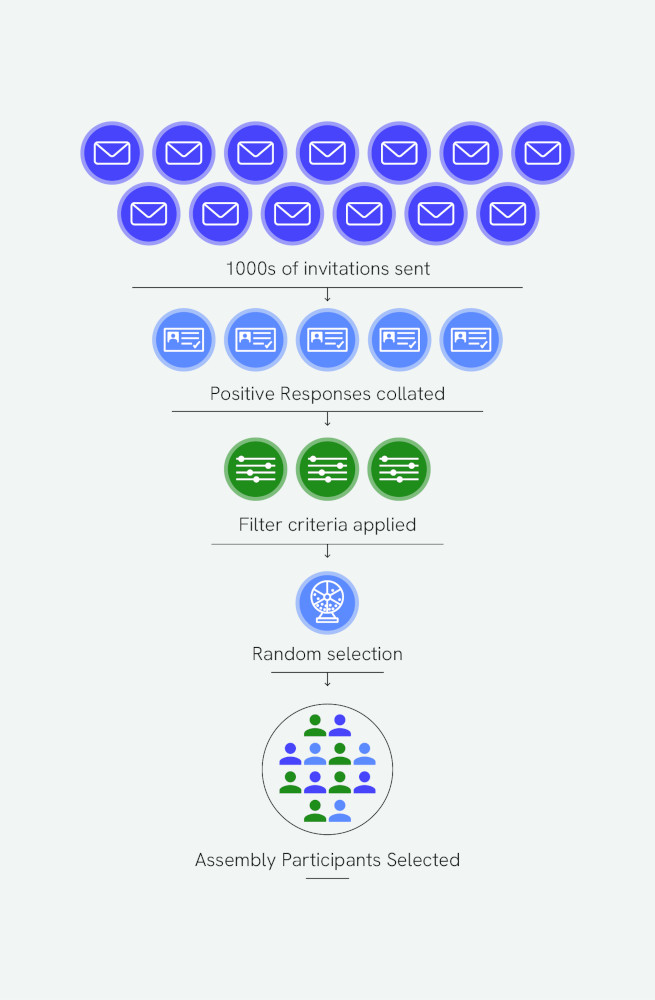
The accepted standard procedure for selection is a two-stage democratic lottery. In the first stage, thousands of invitations are sent out to randomly selected addresses or phone numbers. In the second stage, members are randomly selected from the pool of volunteers using targets to ensure that the final assembly members resemble the wider population in relation to selected characteristics. Figure 1 provides a visual representation of the lottery process. The recruitment process is often carried out by a specialist organisation (on occasion a government statistics agency), although open-access software is available to enable the application of selection criteria. Once assembly members have been selected, resources are needed to ensure that they turn up on the day and stay committed to the process.
Thousands of invitations are sent out, typically by letter to randomly selected households, although the French Convention used randomly generated phone numbers (landlines and mobiles) and the Danish national Climate Assembly used e-Boks, Denmark’s official digital mailbox, used by public authorities to communicate with all citizens. Written invitations will often be in an official envelope and/or on headed paper to increase the chance that respondents take the invitation seriously. The letter will include the following information:
Those who are interested in participating are asked to provide consent to be included in the selection pool, along with personal details.
Those who volunteer to be part of the assembly in Stage 1 will not be well balanced: respondents will tend to skew towards people with higher education and income and those who are slightly older, with less from minority ethnic and poorer communities or from families with young children.
To ensure a balanced group of assembly members, targets are applied so that members mirror the wider population across salient criteria. That is why volunteers are asked to provide information about themselves when responding to the invitation.
Target criteria vary, but most assemblies include some combination of socio-demographic criteria:
Beyond those demographic criteria, others may be specific to the remit of the assembly. If the topic is transport, for example, organisers may add criteria for the different modes used across the population (public transport, car, bike, walking) and/or where the person lives (city centre, suburbs, rural area), so that salient differences in experience are present within the assembly. This is best done when reliable statistics are available on the composition of these characteristics in the wider population.
Some climate assemblies have also applied attitudinal criteria: generally, a measure of level of concern about climate change (or the specific topic of the assembly) which can be compared to national statistics. This is a way of explicitly defending against the criticism that the assembly is full of climate activists. Where such a criterion has not been applied, members have tended to be more concerned about climate change than the wider population, which opens the assembly up to accusations of bias and illegitimacy from the start. Where statistics on demographic criteria are often readily available, statistics on attitudes can be harder to come by.
In places marked by high levels of political polarisation, such as the United States, voting intentions have also been added as a filter criterion to ensure that the assembly straddles political divides, although this is a less stable criterion.
Some assembly advocates argue that climate justice requires that minority groups – especially those with direct experience or under direct threat of climate change – have increased representation in climate assemblies to ensure that their voice is heard. This is in tension with the argument that the legitimacy of an assembly rests on its resemblance with the wider population. There is no right answer. This will be a political judgement on the part of organisers and will need to be documented.
While democratic lottery has two stages, a third element is critical. We need to make sure selected members attend – and then stay for the duration of the assembly. Member support is needed from the moment recruitment starts to the end of the assembly – and arguably beyond.
None of the assembly members will likely ever have been asked to do anything like this before. For some, that will be exciting and increase their motivation to participate. For others, the approaching start date of the assembly generates anxiety. Attendance at an assembly can be daunting - practically and emotionally. Organisers should develop a supportive relationship with members, often ensuring that transport is arranged along with any care that is needed for family members (including children).
For those assemblies that take place partly or fully online (more common during and since the pandemic), member support can involve providing Wi-Fi and hardware for those without the necessary technology and capacity building for those unfamiliar with relevant software. Stories have been shared of organisers standing outside a participant’s front window during the pandemic making sure that they are comfortable and confident in using new equipment and online platforms!
Anyone who drops out between being selected and the start of the process can be replaced, using the remaining pool of people who have not yet been selected.
Climate assemblies often provide access to psychological support for members during the assembly – some will never have considered the existential effect of climate change – and as part of aftercare, although in practice this is rarely used.
If done right, democratic lottery plus ongoing member support has impressive impact on retention rates.
Democratic lotteries require resources, time and care. It is an investment that cannot be overstated, otherwise the legitimacy of the assembly will be undermined.
Make sure that details of how the assembly was selected is publicly available. It will be useful for countering criticisms of the assembly, like accusations that the assembly is made up of activists.
Use a two-stage democratic lottery. In the first stage send invitations to randomly selected individuals, households or phone numbers. In the second stage randomly select from the pool of volunteers, using salient targets. Open access software is available to support both stages – or the whole process can be subcontracted to a specialist organisation.
Consider supplementing socio-demographic criteria – such as gender, age, ethnicity, education and geographic location – with criteria related to relevant behaviours and climate attitudes. This works best if robust, recent population data is available for comparison.
Consider targeted outreach in communities that tend not to respond to invitations and tailor the outreach method to fit the context in question.
Consider over-sampling structural minorities to increase their presence in the assembly and to guard against drop-out.
Providing an honorarium and care support helps increase the diversity of people putting themselves forward and staying with the process.
Building a personal relationship with members before and during the assembly will help ensure attendance and retention. This requires resources.

The Knowledge Network on Climate Assemblies (KNOCA) aims to improve the commissioning, design, implementation and impact of climate assemblies, using evidence, knowledge exchange and dialogue. We are an active community of policy makers, practitioners, activists, researchers and other actors with experience and interest in climate assemblies who co-create activities and knowledge.
